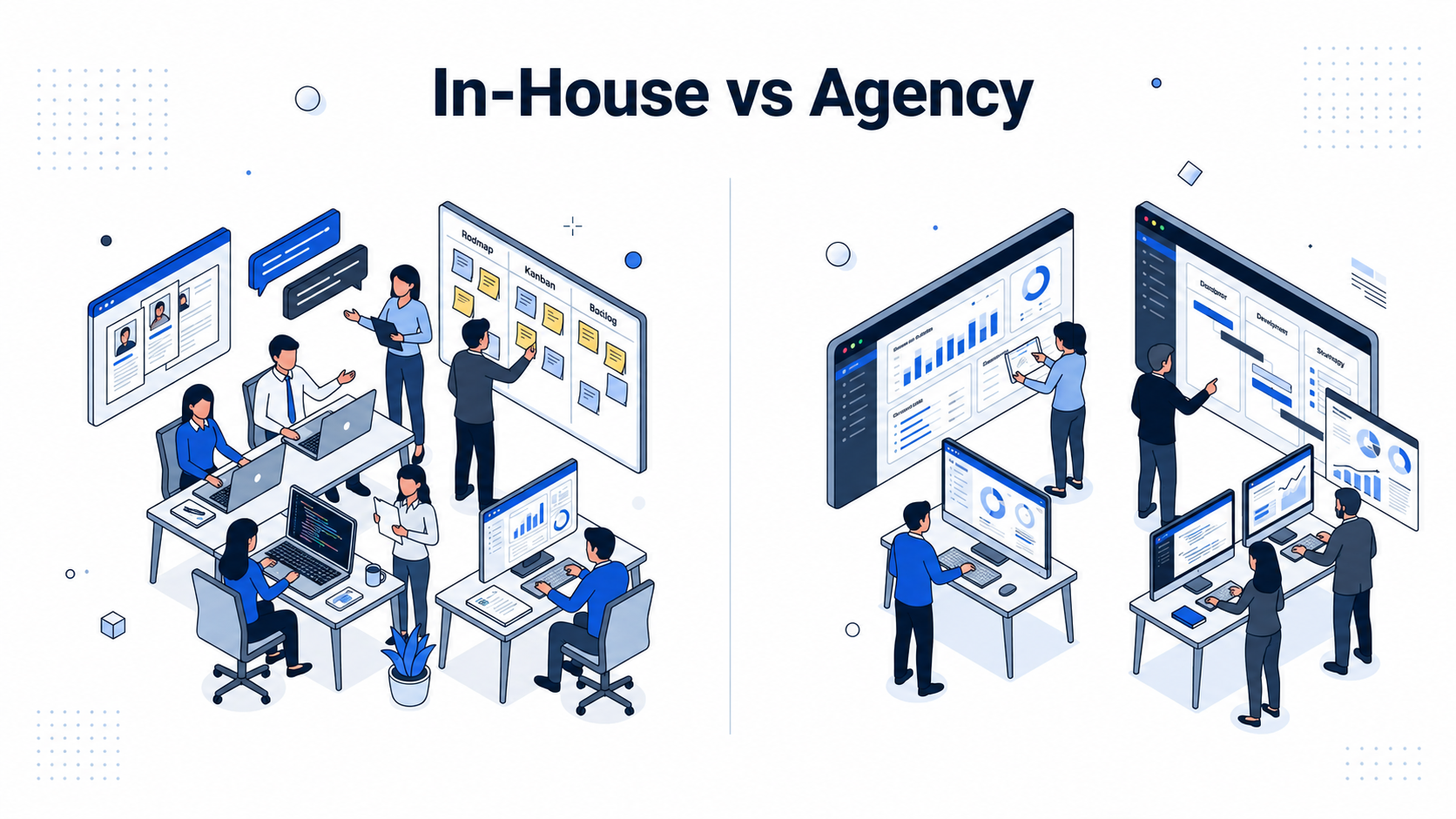





Webflow vs custom development is not just a comparison between using a managed web platform but also about building a bespoke website stack from frameworks like React or headless CMS architectures. For SaaS & B2B companies, the decision centers on execution risk, governance, and long-term ownership.
Introduction
The comparison appears during shortlisting, not exploration.
Teams asking this question usually have:
- Proven GTM motion
- Active SEO and content programs
- Internal engineering constraints
- A need to scale pages without rebuilds
The decision is not about “can we build this.” It is about whether we should own this complexity.
What “custom development” actually means in SaaS contexts
Custom development typically includes:
- React or Next.js frontends
- Headless CMS platforms
- Custom hosting and deployment pipelines
- Ongoing engineering ownership
This approach maximizes flexibility but also shifts ongoing responsibility onto internal teams. Webflow, by contrast, centralizes CMS, hosting, layouts, and publishing under a governed system.
Webflow vs React websites for SaaS GTM pages
React-based sites excel at application-level logic and dynamic interfaces.
They struggle when used as marketing systems.
Common issues include:
- Engineers becoming content gatekeepers
- Slow iteration on GTM experiments
- Higher QA overhead for page changes
Webflow separates marketing execution from product engineering while preserving predictable HTML output. For SaaS teams, this distinction matters more than raw technical capability.
Webflow vs headless CMS architectures
Headless CMS setups offer flexibility but introduce system coordination risk.
Typical challenges:
- Multiple vendors and APIs
- SEO efforts drift across multiple teams
- Visual consistency becomes difficult to manage over time
- Higher cost of change over time
Webflow’s CMS enforces structure visually, which limits flexibility but improves governance. This trade-off often favors Webflow for SaaS marketing websites, not product surfaces.
Enterprise scalability and Webflow limitations
Webflow limitations appear at the edges:
- Custom ways of getting work done: Custom-built systems that match exactly how your team works.
- Deep backend integrations: Connecting your website so it "talks" perfectly to your other software.
- Multi-region content with complex permissions: Running sites for different countries while controlling exactly who can edit what.
However, many “enterprise limitations” are actually process issues, not platform constraints. Custom stacks scale technically, but organizational scalability depends on discipline and documentation and engineering teams.
Maintainability and ownership over time
Webflow ownership model
- Centralized system
- Lower operational overhead
- Faster onboarding for marketing teams
- Reduced dependency on engineers
Custom development ownership model
- Maximum control
- Higher ongoing cost
- Slower iteration without dedicated teams
- Increased bus-factor risk
SaaS teams must decide whether owning infrastructure improves outcomes or slows execution.
SEO, performance, and risk comparison
Webflow
- Predictable markup
- Built-in hosting optimization
- Lower regression risk during updates
Custom development
- Performance depends on team discipline
- SEO quality varies by implementation
- Higher risk during refactors
For SEO-led SaaS growth, consistency often outperforms theoretical optimization.
When custom development / Webflow is the right choice
Custom development fits when:
- The website requires application-level logic
- Engineering bandwidth is stable and dedicated
- CMS flexibility outweighs governance risk
- Marketing velocity is secondary to system integration
Webflow fits when:
- Marketing owns GTM execution
- SEO stability matters
- Page velocity impacts revenue
- Teams want fewer rebuild cycles
Looking beyond build choice to long-term ownership
Some teams take a more careful approach.
Instead of asking what can be built, they focus on what can be maintained, governed, and safely changed over time.
In this model:
- Systems are designed to survive team changes
- Operational clarity matters more than visual novelty
- Websites are expected to be edited and expanded regularly
- Rebuild risk is treated as a real cost
- Structure and clarity improve with use
This is the operating model Minute Creative follows when helping SaaS teams choose between Webflow and custom development.
High-Intent takeaway
If your SaaS website supports growth, pipeline, or positioning, how it is built becomes a long-term risk decision. If you are deciding between Webflow and custom development, the most important factor is not the tool itself, but how the website will be owned, updated, and scaled over time.
Unsure whether to go Webflow or custom-built? Book a call today.

.png)