




Most enterprise software websites look the same.
A dark hero section. A rotating headline about "transforming" something. A logo strip of Fortune 500 names. A CTA that says "Request a Demo." Then three product tabs, a security badge, and a testimonial from someone with a title so long it barely fits in the quote box.
It's not that these websites are badly designed. Most of them are polished. The problem is that they all feel like they were built from the same template, with the same instinct: look big, sound safe, and avoid saying anything that might lose a deal.
The irony is that this approach loses deals constantly. Because enterprise buyers, the ones with real budgets and real authority, don't make decisions based on who looks the most impressive. They make decisions based on who understands their specific problem the best. And a website that tries to appeal to everyone signals, immediately, that it was built for no one in particular.
Good enterprise website positioning does the opposite. It makes a very specific buyer feel like you built the whole company for them. Here's what that looks like in practice.
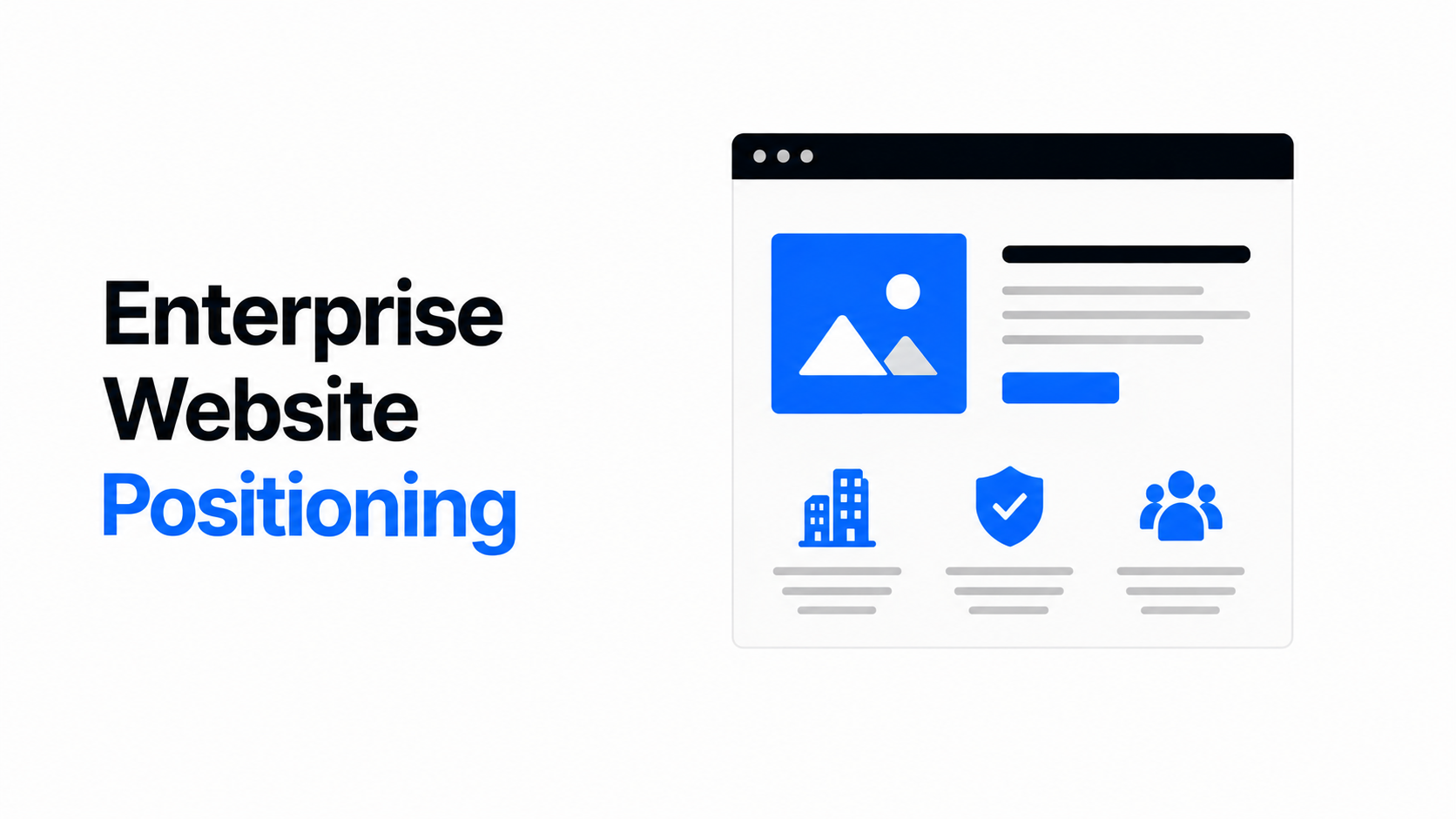
What Is Enterprise Website Positioning?
Enterprise website positioning is the way a company communicates its value, its category, and its differentiation to enterprise buyers through its website. It's not just the headline on the homepage. It's every signal the site sends about who you are, who you serve, what problem you solve, and why you're the right choice over the alternatives a procurement team is also evaluating.
The reason enterprise positioning is its own discipline, separate from general B2B positioning, is that enterprise buying is structurally different. There's no single decision-maker. A typical enterprise software deal involves six to ten stakeholders, each with different priorities, different vocabularies, and different definitions of success. The champion who finds your product cares about features. The CFO cares about the total cost of ownership. The CISO cares about data residency and compliance. The VP of Operations cares about implementation timelines and change management.
Your website has to speak to all of them, without becoming so general that it stops speaking to any of them. That's the core challenge of enterprise website positioning, and it's why most enterprise websites default to vague language that feels safe but converts nobody.
The Three Layers of Good Enterprise Positioning
The best enterprise websites don't try to do everything on every page. They think in layers. Each layer serves a different buyer, a different stage of the decision, and a different question.
The first layer is the category layer. This is where you define what you are and what category you belong to, or whether you're creating a new one entirely. Salesforce didn't position itself as "software for managing contacts". They defined an entirely new category: CRM delivered as a service, in the cloud, with no hardware required. Their website in the early days wasn't competing on features. It was competing on the idea that there was a better way to do this altogether. That category claim did more for their enterprise sales motion than any feature comparison ever could have.
The second layer is the problem layer. This is where you articulate the specific pain your enterprise buyer is living with before they find you. Not a generic pain. A named, specific, recognisable pain that makes the buyer feel like you've been watching their internal meetings. Snowflake's website doesn't just say "data warehousing made easy". It names the exact frustration: data silos, slow queries, and infrastructure that can't scale with the business. Every enterprise data team reading that recognises themselves. Recognition is the first step toward trust.
The third layer is the proof layer. This is where you show, specifically, that you've solved the problem for buyers who look exactly like the one reading your site. Not logo drops. Not generic case studies. Named outcomes for named companies in named industries, with real numbers attached. "We reduced reporting time by 60%" from a company your buyer has heard of, in an industry your buyer is in, is worth more than ten generic testimonials from companies they've never encountered.
What the Best Enterprise Websites Do Differently
Spend time studying the websites of enterprise software companies that are genuinely winning, and a few patterns become clear.
They lead with the buyer's world, not their own product. HubSpot's enterprise positioning doesn't open with a feature list. It opens with a description of what life looks like for a revenue team that's grown too fast for fragmented tools. The buyer reads it and thinks "that's us." Drift, before their acquisition, built their entire enterprise website narrative around a single problem: enterprise sales teams were too slow to respond to website leads, and by the time they did, the buyer had moved on. Every word on their site reinforced that one idea.
They have a clear point of view on how the market is broken. The strongest enterprise positioning includes an explicit stake in the ground about why the existing category is failing buyers. Notion did this brilliantly when they launched their enterprise product. Their positioning wasn't just "we have better docs." It was "the tools your enterprise bought ten years ago were built for a way of working that no longer exists." That kind of positioning doesn't just differentiate. It creates urgency. It tells the buyer that staying on the current tool is itself a risk.
They write differently for different buyers without creating a fragmented experience. Figma's enterprise website is a good example of this. The surface-level experience is unified: one visual identity, one narrative thread about what collaboration should look like. But the content paths diverge quickly. Designers find their language. IT and security teams find their language. Finance and procurement find what they need on pricing and compliance pages. Each persona feels served without the site feeling like it was split into separate brochures.
The Positioning Mistakes That Cost Enterprise Deals
Understanding what good looks like also means understanding what breaks enterprise deals before they start.
The first mistake is feature-forward positioning at the expense of outcome clarity. Enterprise buyers don't buy features. They buy outcomes that they can justify to a committee. A website that leads with a feature matrix and buries the business impact forces the buyer to do translation work that most of them won't do. The website should do that work for them.
The second mistake is positioning to the champion while ignoring the economic buyer. The champion is the person inside the enterprise who finds you and advocates for you. The economic buyer is the person who signs the check. These two people have almost nothing in common in terms of what they need from your website. If your positioning only resonates with the champion, you'll get interest but not signed contracts. Economic buyers need to see business case language, ROI framing, risk mitigation signals, and enterprise-grade proof. If those aren't visible on your site, you're asking the champion to build the entire case from scratch.
The third mistake is positioning that works in a pitch deck but not on a website. Enterprise sales teams often have excellent verbal positioning. When a rep is in the room, they tailor the message, read the room, and land the point. The website doesn't have that luxury. It has about eight seconds and a hero headline. If your positioning requires context, nuance, or a relationship to land, it will not land on a website. The test is simple: if someone who knows nothing about your company reads your homepage for thirty seconds, can they explain what you do and who it's for? If the answer is no, the positioning isn't web-ready.
How to Know If Your Enterprise Positioning Is Working
There are three signals that tell you your enterprise website positioning is doing its job.
The first is qualified inbound. When your positioning is sharp, the leads your website generates are already pre-qualified. They come in with language that mirrors yours. They reference specific problems from your website in their first email. They've already eliminated alternatives before they reached out. Unqualified leads and "just browsing" enquiries are often a sign that your positioning is broad enough to attract everyone and specific enough to convert no one.
The second is sales cycle acceleration. When positioning does its job on the website, the early sales conversations change in character. Instead of spending the first two calls establishing what your product does and whether it's relevant, the buyer arrives already orientated. The conversation starts at evaluation, not education. That's time saved across dozens of deals, which compounds into a meaningfully faster average sales cycle.
The third is the language your buyers use. When enterprise buyers repeat your positioning language back to you in discovery calls, in internal emails you get forwarded, and in the way they describe your product to colleagues, it means your positioning has become the frame they use to think about the problem. That's the highest form of positioning success. It means you own the category in their mind, and every competitor gets evaluated relative to you.
Enterprise Positioning Is a Website Problem as Much as a Marketing Problem
Here's the part that most enterprise marketing teams underestimate. Even when the positioning strategy is right, even when the messaging framework is solid and the deck is sharp, the website can still fail to communicate it.
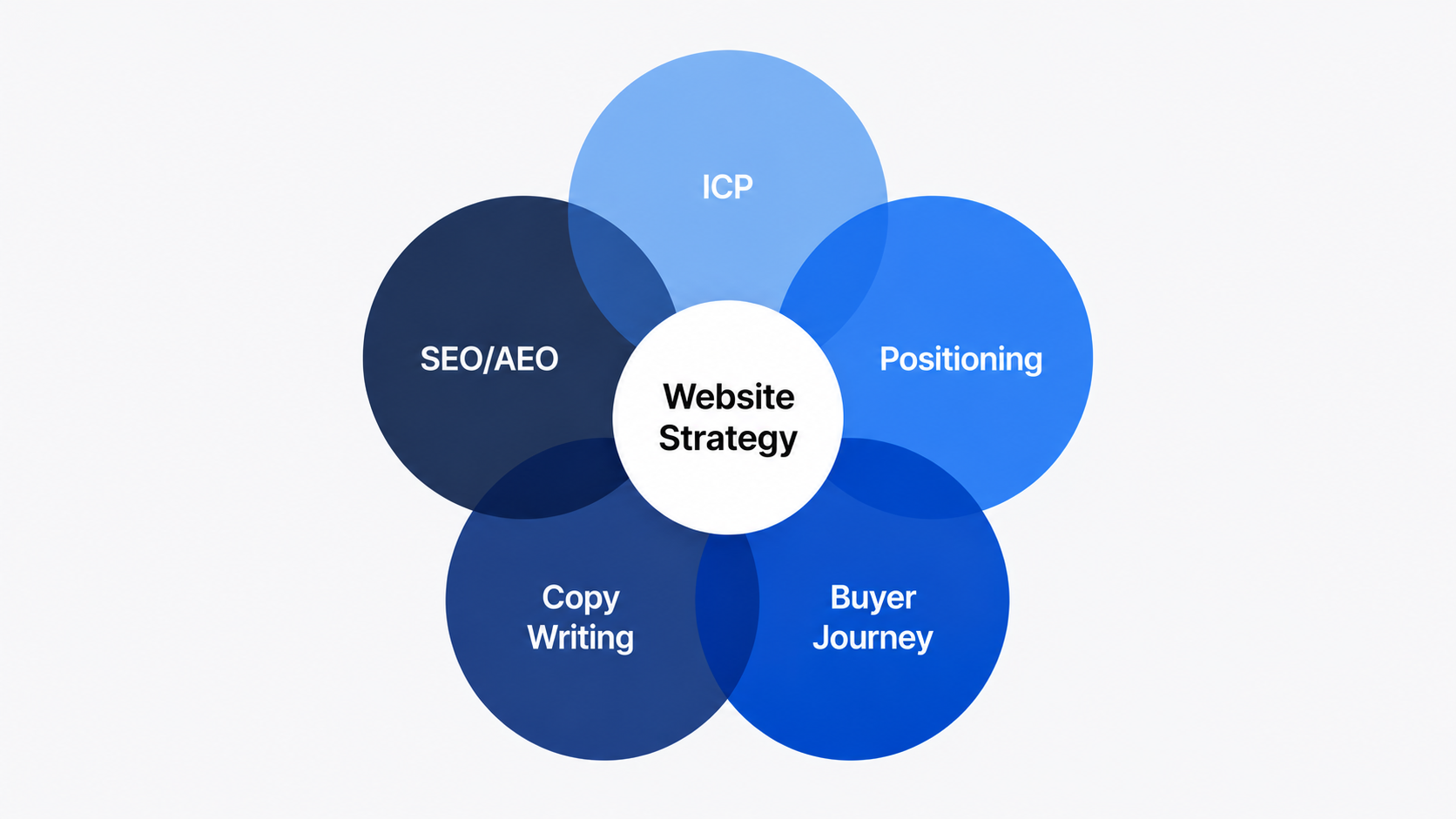
Enterprise website positioning requires a website that's built to carry the message. The right information architecture, the right content hierarchy, and the right visual weight given to the right claims. A positioning strategy written in a Google Doc and pasted into a template that wasn't built for it will underperform every time.
This is why the website build and the positioning strategy need to happen together, not sequentially. When Webflow development is done alongside messaging work, every design decision reinforces the positioning rather than fighting it. The result is a site where the strategy and the execution are aligned, and enterprise buyers can feel the difference, even if they can't articulate why.
Your Enterprise Buyers Are Judging You Before the First Call. Is Your Website Ready?
Enterprise deals don't start when a rep picks up the phone. They start when a buyer types a search query, lands on your website, and decides in the first thirty seconds whether you're worth their time.
If your website is still speaking in feature lists, still hedging its positioning to avoid excluding anyone, and still treating all visitors as if they're the same buyer at the same stage, it's costing you deals you'll never even know you lost.
Good enterprise website positioning is specific, layered, and built for the buyer's world, not your org chart. Getting it right is the highest-leverage thing a B2B SaaS company can do before scaling its sales motion.
Minute Creative specialises in enterprise website positioning for B2B SaaS companies. We combine positioning strategy, Webflow development, and conversion-focused design so your website does the sales work before your team even gets on a call.
Book a free strategy call and let's look at what your enterprise buyers see when they land on your site.
.jpg)